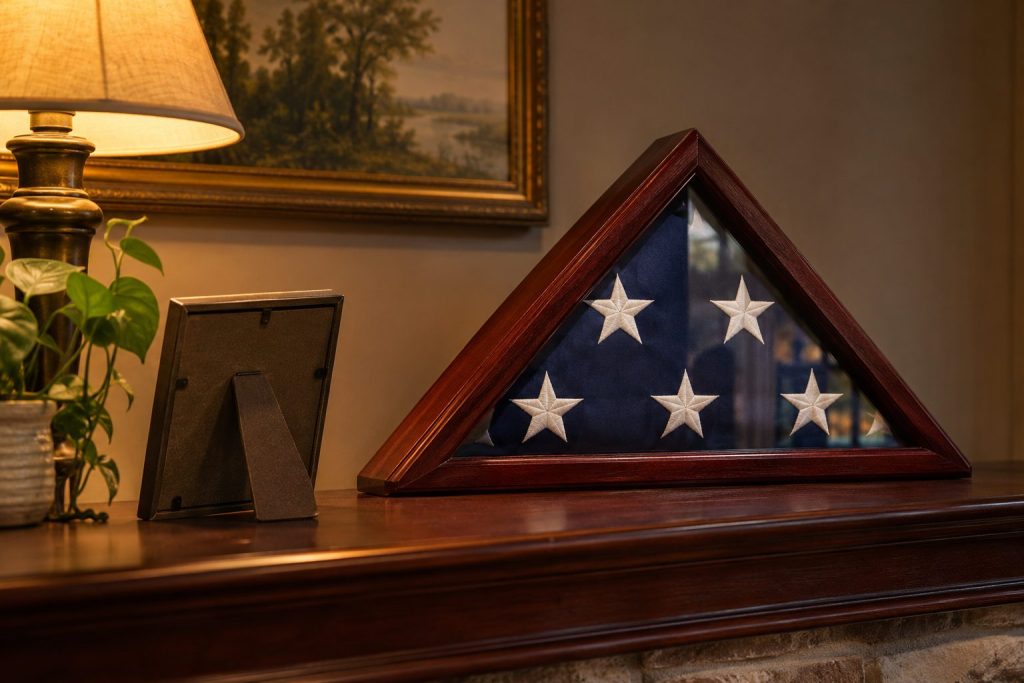
Most families keep a burial flag folded in its triangle and display it in a flag case, out of direct sunlight, often with the veteran’s medals and a record of their service. A burial flag is the U.S. flag that drapes a veteran’s casket or accompanies the urn, and it is presented to the next of kin at the funeral. Because the Department of Veterans Affairs provides only one burial flag per veteran, protecting it matters. This guide explains how the flag is folded, how to display and store it, and whether it can be flown.
What is a burial flag?
A burial flag is a U.S. flag provided by the Department of Veterans Affairs (VA) to drape the casket or accompany the urn of a veteran who served honorably. The next of kin, or a close friend, receives the flag; families apply with VA Form 27-2008 through a funeral director, a VA regional office or a U.S. post office, and only one burial flag is provided per veteran, according to the VA burial flag page.
The burial flag is larger than a typical house flag. Flag makers that produce the government-style interment flag describe it as cotton, 5 feet by 9.5 feet, with embroidered stars and sewn stripes.
How is a burial flag folded?
A burial flag is folded 13 times into a tight triangle, with only the blue field of stars showing. The honor guard folds it lengthwise twice, then makes triangular folds from the striped end until only the stars remain, and tucks the last edge into the fold. The finished triangle is what families display.
Leave the flag in its triangle. Once a burial flag is unfolded, it is hard to refold it as neatly as the honor guard did, and most display cases are made for the folded shape.
How do you display a folded burial flag?
To display a folded burial flag, place it in a triangular flag case with a glass front, then choose a spot away from direct sunlight, heat and humidity. Follow 4 steps:
- Choose a case made for a folded 5 by 9.5 foot burial flag; a case sized for a smaller flag will not close.
- Place the triangle with the stars facing out.
- Hang the case on a wall or stand it on a shelf or mantel, out of the path of direct sunlight, which fades cotton over time.
- Add a short record of the veteran’s name, branch, rank, dates of service and the date of the funeral, on a card or a plate.
Many families add medals, a photo or a challenge coin beside the flag. Muster USA has wood-frame, glass-front memorial flag cases for the wall or tabletop; check the case size on the product page, or ask us, before you order.
Can you fly a burial flag?
You can fly a burial flag, but most families do not. The cotton interment flag is large and heavy for a house flagpole, and wind, rain and sun wear it out quickly. Opinions differ among veterans and historians on whether the flag should be flown at all; a common choice is to keep the burial flag folded and fly a separate flag on days like Memorial Day and Veterans Day.
How do you store a burial flag safely?
To store a burial flag safely, keep it folded in a closed case or an acid-free box, in a dry room with a stable temperature. Avoid basements, attics and garages, where moisture and heat damage cotton, and avoid plastic bags that trap humidity. Handle the flag with clean, dry hands.
What should you do with a worn or damaged flag?
A U.S. flag that is worn beyond use should be retired with dignity. The U.S. Flag Code states that a flag “in such condition that it is no longer a fitting emblem for display” should be destroyed in a dignified way, preferably by burning (4 U.S.C. § 8(k)). Veterans organizations and many local posts hold flag retirement ceremonies. A burial flag is rarely retired this way; families usually keep it, even if faded.
Who keeps the burial flag in the family?
The person who receives the burial flag at the funeral keeps it, usually the spouse or the next of kin. Families often pass the flag to a child or grandchild later, or decide that one family member keeps the flag while others keep a medal, a photo or a keepsake gift for a veteran instead. Because only one burial flag is issued per veteran, talk about it as a family before the funeral if you can.